60 Buckingham street, Lara, Victoria, Australia

60 Buckingham street, Lara, Victoria, Australia
Mon - Sun 6:00 am to 8:00 pm

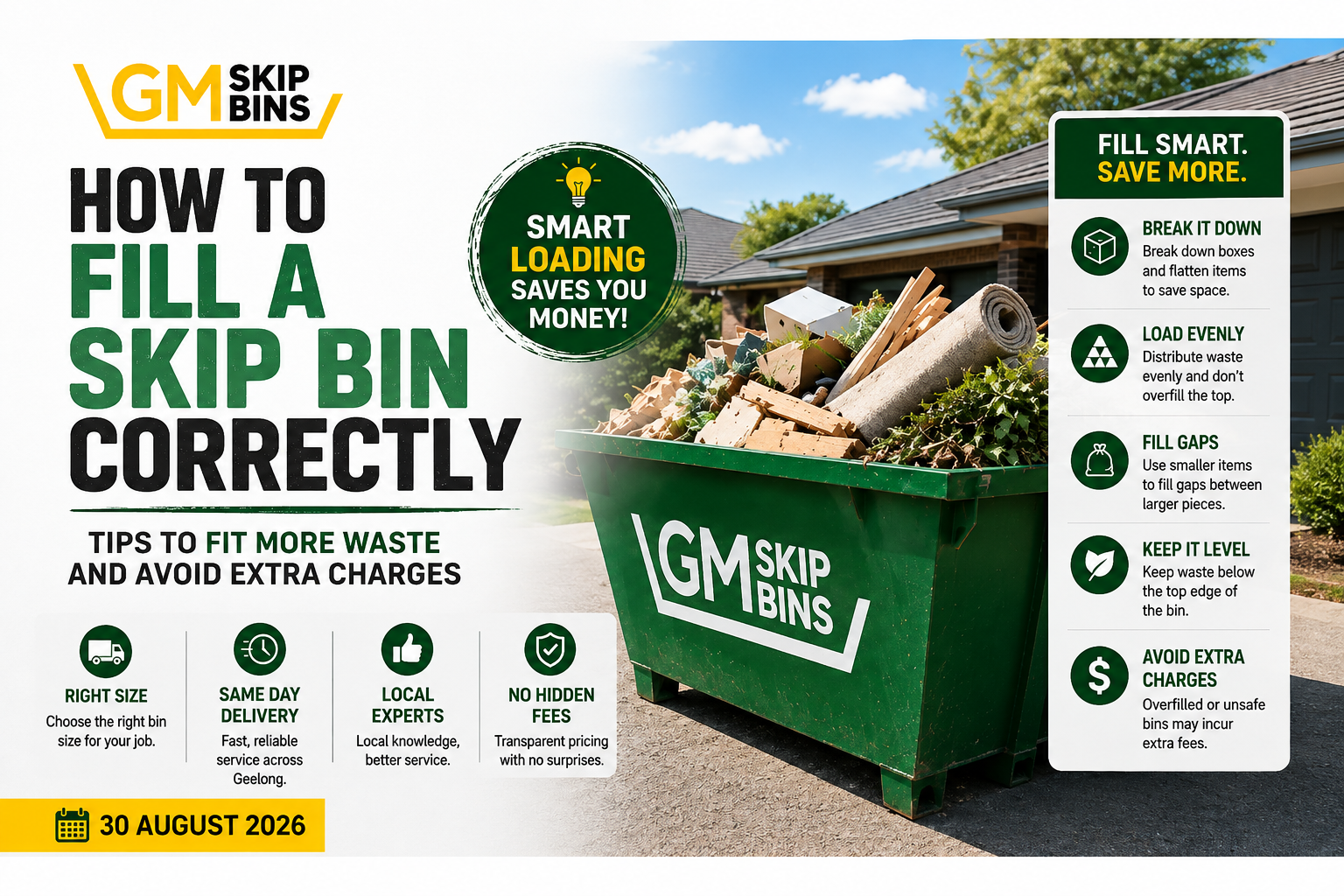
You have booked a skip bin, it is sitting in your driveway, and you are about to start loading. Most people treat this as a straightforward task — pick up rubbish, throw it in, repeat until the bin is full. And for simple jobs, that approach works fine.
But for anyone doing a serious garage clean-out, a renovation, a deceased estate clear-up, or a landscaping job — the way you load a skip bin makes a significant difference to how much you fit in, how much you pay, and whether you end up with an overfilling charge or a pile of overflow that has nowhere to go.
The rules are not complicated. This guide covers everything you need to know to fill a GM Skip Bin correctly, get maximum value from the capacity you have paid for, and avoid the extra charges that catch people off guard.
The single most impactful loading principle for any skip bin job is also the most commonly ignored. Heavy, flat items go in first — at the bottom of the bin — and lighter, bulkier items go on top. This is not just about weight distribution for safe transport. It is about creating a stable, compact base that allows you to stack more on top without creating unstable gaps that waste space.
When light, irregular items go in first — bags of rubbish, cushions, garden waste — they create an uneven base that leaves large air pockets underneath everything loaded on top. Heavy items loaded on top of that unstable base shift during filling, create more gaps, and compress inconsistently.
Starting with flat, heavy items — timber panels, cabinet doors, shelving, tiles, concrete chunks — creates a solid, level surface that everything else sits on efficiently. Soil, bricks, and concrete should always go in first if the bin type accepts them.
The volume of waste in a skip bin is determined entirely by how tightly items can be packed together. Items that go in whole — intact furniture, full mattress frames, complete shelving units — leave enormous air pockets around them that waste paying space.
Before an item goes into the bin, ask one question: can this be made smaller? Almost always the answer is yes.
Furniture — Remove legs from tables and chairs. Dismantle flat-pack furniture completely rather than loading it assembled. Take drawers out of cabinets and stack them separately. Break down bed frames into individual components.
Timber and timber products — Cut long lengths of timber down to a manageable size. Break up MDF shelving, chipboard, and plywood rather than loading whole panels that resist flat stacking.
Cardboard and packaging — Flatten every box completely before loading. Unflattened cardboard boxes take up three to four times the space of flattened ones. A renovation that generates significant cardboard can fill a small bin with packaging alone if boxes are not broken down first.
Garden waste — Chop branches into shorter lengths and feed them into gaps rather than loading them whole. Long branches loaded across the top of a bin create a lattice that prevents further loading above them. Green waste compacts significantly better when cut into shorter lengths.
Bags of rubbish — Do not load bags upright. Lay them flat and press the air out before placing the next item on top.
Most people fill a skip bin the way they would stack boxes — working vertically, one layer at a time. The result is a bin that appears full before it actually is because large irregular items create gaps at their sides that are never filled.
The correct approach is horizontal — filling every gap across the full width of the bin before building upward. Think of it the same way you would pack a suitcase rather than a box. Small items fill the gaps around larger items. Soil fills the spaces between bricks. Bags of rubbish fill the spaces around furniture components.
Specifically:
After each layer of larger items is placed, fill every visible gap with smaller, loose material before placing the next layer. Small rubble, bags, loose soil, leaves, and packaging are all ideal gap-fillers. The goal is zero visible air space between items before the next layer goes down.
Work from the back of the bin toward the front so you can see what you are filling as you go without climbing into the bin to reach the back.
This sounds obvious until you are standing next to a skip bin wondering why it looks half-empty but feels full. Flat items — panels, boards, cabinet doors, mattresses laid flat — stack efficiently because they make full contact with the surface beneath them. Round, curved, or irregular items — buckets, tyres, garden pots — do not stack efficiently because they leave curved gaps underneath and between them.
Whenever possible, choose the orientation of each item to maximise flat contact with the items below it. A chair placed on its back takes up less space than a chair placed upright. A mattress placed flat takes up less than a mattress placed on its side. A bin bag pressed flat and placed horizontally takes up less than the same bag placed upright and round.
Every skip bin has a fill line — also called the load line — marked on the inside of the bin walls. This line indicates the maximum legal fill level for that bin when it is being transported on a public road.
In Victoria, skip bins transported on public roads must not be loaded above the top rim of the bin and must not have material protruding above the bin walls. Overfilled bins cannot legally be collected by the delivery truck — and bins that are collected with material above the fill line expose the driver and the customer to penalties under Victorian transport regulations.
The practical consequence for GM Skip Bins customers is straightforward: if a bin is overfilled when the collection truck arrives, the driver cannot legally collect it until excess material is removed. That removal costs time and in some cases an additional fee depending on the volume of overflow. It is always faster and cheaper to stay below the fill line than to deal with an overfilled collection.
Signs your bin is approaching the limit:
Material is reaching the top rim of the bin walls on any side. Items are protruding above the bin walls when loaded naturally. You cannot see the original fill line mark anymore from the outside.
When the bin reaches this point, stop loading. Call GM Skip Bins on +61 415 968 904 to discuss whether a swap-out or an additional bin is the right next step. We will always give you a straight answer about the most cost-effective option rather than leaving you guessing.
Learn more - Complete Guide to Geelong Bin Collection Services: Recycling, Green Waste & Hard Rubbish
The top layer of a skip bin is the most visible during transport and the most likely to cause overfill issues. Certain items loaded at the top create problems regardless of fill level:
Long items protruding above the rim — Timber lengths, metal rods, garden stakes, pipes, and similar items that extend above the bin walls are a transport hazard. Cut these down to fit within the bin walls before loading, or load them diagonally across the width of the bin if length allows.
Loose light material on top — Leaves, dust, light packaging, and small loose debris loaded at the top can blow off during transport. Weigh light top-layer material down with heavier items, or bag it before placing it at the top.
Unstable stacked items — Anything that could shift, fall, or collapse during transport should not be loaded at the top of the bin without securing it beneath heavier material.
This applies particularly to jobs that involve a mix of heavy material — brick, concrete, soil — alongside general waste and green waste. Loading mixed waste into a single bin is convenient in the moment but often costs more at disposal because contaminated loads cannot be processed at the cheaper recycling stream.
The practical rule: if your job generates both heavy inert material and general waste, call GM Skip Bins before booking and discuss whether a Clean Fill bin for the heavy material and a General Waste bin for everything else works out cheaper than a single Mixed Heavy Waste bin. On large jobs the answer is often yes — and the saving is significant.
For anyone who wants the short version before starting:
Load heavy flat items first — timber, tiles, concrete, panels — to create a stable base. Break down all furniture, cardboard, and timber before loading. Fill every horizontal gap before adding the next layer. Lay bags flat and press air out before stacking. Cut long items to fit within the bin walls. Stop loading when material reaches the top rim. Separate heavy inert material from general waste where possible.
Follow these steps and most jobs fit more into the bin they booked — which means fewer overweight charges, fewer overflow issues, and no need for a second collection on a job that should have fit in one.
GM Skip Bins delivers across Geelong, Lara, Torquay, Belmont, Drysdale, Ocean Grove, Barwon Heads, Leopold, and surrounding suburbs — same day for morning bookings. Skip Bins from 2m³ to 9m³ for residential jobs and Hook Bins from 8m³ to 30m³ for construction and commercial work. All waste types accepted across the full range.
Not sure what size suits your job? Call us before booking and describe what you have — we will recommend the right size based on what you are actually dealing with rather than upselling to a bin you do not need.
Book a skip bin in Geelong online or call us directly.
📞 +61 415 968 904
📧 Info@gmskipbins.com.au
📍 60 Buckingham Street, Lara, Victoria
🌐 gmskipbins.com.au